
- FY2012 Outstanding Civil Engineering Award for “Technological Development”
Description
Improves existing manholes without excavation. Suppresses manhole uplift caused by soil liquefaction and ensures proper sewage flow.
Earthquakes (Liquefaction) and the Floatless Method
In recent years, earthquakes such as the Tokachi-oki Earthquake and the Niigata Chuetsu Earthquake caused soil liquefaction due to strong tremors, resulting in numerous manholes rising above the surface. Manhole uplift during an earthquake can disrupt sewage systems and impair their drainage function. In addition, protruding manholes obstruct traffic, hindering emergency vehicles and disrupting rescue operations for disaster victims.
To mitigate this manhole uplift phenomenon as much as possible, we developed the Non-Excavation Manhole Uplift-Prevention Method (Floatless Method). This method involves installing dissipation valves in the manhole wall to instantly release excess pore water pressure generated during an earthquake, thereby suppressing manhole uplift.
Floatless Method Concept
Excess pore water pressure generated during an earthquake is instantly dissipated through special pressure dissipation valves. In this way, liquefaction around the manhole is reduced and manhole uplift prevented.
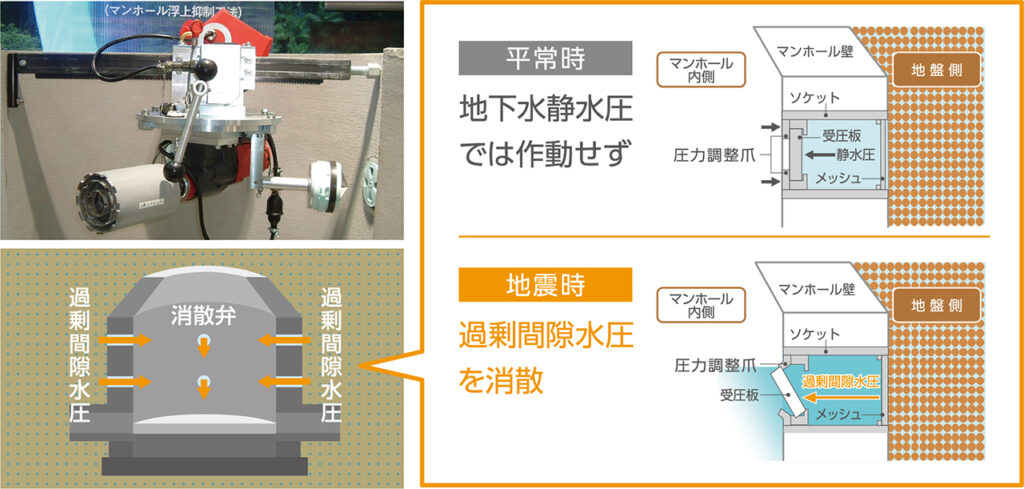
Floatless Method Concept
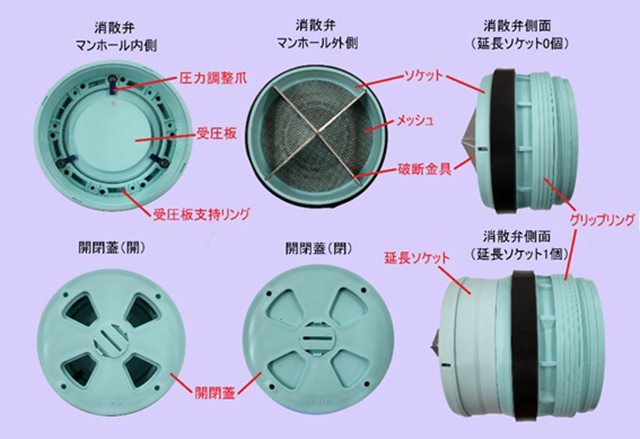
Dissipation Valve
Features
Fast installation from inside manhole without excavation
A special machine is used to drill holes from inside the manhole for installing the dissipation valves. This eliminates the need for excavation and enables fast, easy, safe, and reliable installation.
Cost-effective installation
Installation cost can be reduced by not having to excavate the existing manhole.
Compatible with all manhole types
This method allows optimal selection of the number of dissipation valves and their position based on the size and depth of the existing manhole. The dissipation valves are made from corrosion-resistant materials.
Does not interfere with regular sewer operation and maintenance
The dissipation valves are embedded in the manhole wall, so they do not obstruct regular sewer operation and maintenance.
Specifications
| Manhole shapes | Circular, rectangular, oval |
| Manhole internal dimensions | Circular: Internal diameter 750~1,500 mm Non-circular: Min. 900 mm, Max. 1,500 mm |
| Dissipation valve installation depth | Within 5 m of ground level |
| Wall thickness | 60~300 mm |
| Notes | Compatible with both new and existing manholes |
Track Record
Since first commercialized in FY2007, this method has been applied to a total of 29,389 manholes in Japan as of the end of FY2023 (1,032 manholes in FY2023). In August 2014, the method was also applied to three manholes in Porirua City, Wellington Region, New Zealand.