
- FY2011 Minister of Land, Infrastructure, Transport and Tourism Awards – Passage of Circulation, Sewerage Award
- FY2019 Outstanding Civil Engineering Award for “Environment”
Description
This technology is a new method for addressing debris in combined sewer overflow during rainfall. It offers power-free operation, easy operation and maintenance, and simple installation in existing CSO chambers.
A control plate is installed at the inlet of the sewage outflow conduit in the CSO chamber, and a guide wall is installed in front of the overflow weir. These induce a vortex flow that directs debris toward the downstream outflow conduit. In combination with existing mechanical filtration screens, it helps reduce the operation and maintenance workload.
-
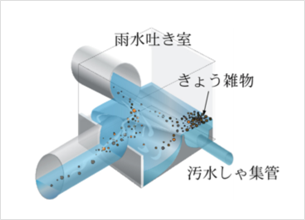
CSO Chamber Before Installation
-
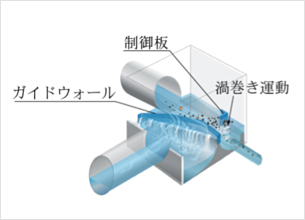
CSO Chamber After Installation
Features
- Simple and cost-effective structure, easy installation inside existing CSO chambers.
- No moving parts, making operation and maintenance easy.
- Requires no power, contributing to energy conservation.
Specifications
The water surface control device consists of the following components.
Guide Wall
Prevents floating debris from being discharged with overflow water and guides it toward the sewage outflow conduit.
Control Plate (Vertical or Horizontal)
Installed near the inlet of the sewage outflow conduit in the CSO chamber to generate a vortex flow that draws floating debris within the CSO chamber into the sewage outflow conduit.
Track Record
Since first commercialized in FY2002, this method has been applied to a total of 1,910 manholes in Japan as of the end of FY2023 (5 manholes in FY2023). It has also been installed in 41 manholes overseas.